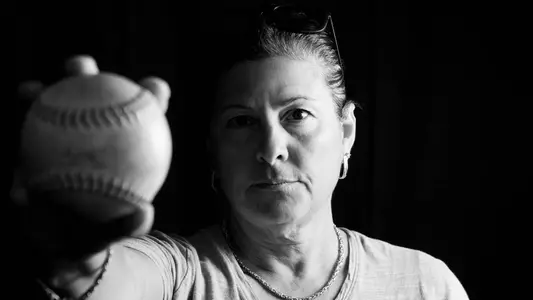
College of Charleston Athletics Year of Women Coach Series: Linda Kalafatis
5/1/2019 5:00:00 PM | Softball
Photo Credit: Marquise Pointer / Athletics Communications Student Intern
NICK VLATTAS
CofCSports.com
 College of Charleston Head Softball Coach Linda Kalafatis is in her 30th season as a collegiate head coach and has contributed greatly to the tremendous growth of the game.
She recalls primitive softball bats, which were flat on one side, or ones with curved handles that helped hitters square the barrel up at impact. Kalafatis has contributed to the evolution of coaching, the rise of specialized trainers and the development of the sport's technology.
But most importantly, she has enabled her student-athletes to grow as people and challenged them to live up to their fullest potential on-and-off the field.
Her journey began in Bethel Park, Pennsylvania, where Kalafatis was born to parents of Greek heritage and unbridled sports passion. Raised in a suburb of Pittsburgh—The City of Champions—Kalafatis recalls attending Opening Day each year at Three Rivers Stadium, which was then home to the Pittsburgh Pirates and Steelers, and gathering around the radio to listen to games whenever they couldn't make it to the bleachers.
Her family was so passionate about Pittsburgh sports teams, that when her younger brother was born in October of 1971, her father didn't make it to the hospital, because the Pirates were on their first World Series run in 11 years.
Despite growing up in such a sports-passionate family, however, her opportunities to compete were few and far between. She was discouraged from participating in any athletics by her mother, and told that it wasn't what traditional Greek women did. Instead, she was required to perform "womanly duties" as they were told to her, and begrudgingly she would iron and put away her brothers' clothes as they headed out to their respective games and competitions.
Kalafatis was a natural athlete and would jump at any opportunity she had to follow her older brother to football or baseball practices and pick-up games. Once there, her brother and the other boys were no match for her skill anytime she picked up a bat or ball.
There were no organized fastpitch leagues in her town, until she finally got her first opportunity to play organized fastpitch softball in the ninth grade. Despite knowing she was good enough, she was still hesitant to try out for the team, because it required getting a physical, which meant telling her mom she was getting involved in sports.
At the encouragement—and even playful threatening—of her friends, she decided to go through with it, and immediately fell in love with the game. During tryouts, she was asked to play catcher, and was ultimately selected for the position despite her desire to be out in the field.
"At first I thought I was selected, because I wasn't good enough to play the other positions, as if I'd lost the draw," Kalafatis said.
But, it didn't take her long to correct herself.
"Once we got going, I quickly understood the responsibility I had at catcher and I realized the impact and visibility I had on the rest of the game," she said. "I realized that I won in being selected to play catcher."
Her love and passion for the game and her newfound position blossomed. She continued to excel over her high school career, despite lacking an opportunity to play on club or developmental teams.
In her early years, college wasn't always on the horizon (her parents only attended school up until the eighth grade), but her dedication and talent opened new doors. Kalafatis enrolled at California University of Pennsylvania where she competed in the Pennsylvania State Athletic Conference (PSAC), which dominated the softball landscape in the region at the time.
 When her NCAA eligibility expired after an illustrious playing career, she was named a student assistant coach in her fifth year of school, only to be named the Vulcans' head coach one year later—at the age of 23.
Her coaching career sprouted from humble beginnings. At the time, she was still living with a couple of her old teammates, who were now her players. Every day, she would sprawl the contents of her briefcase across any open area of the athletics department she could find.
Kalafatis—a perpetual student of the game—quickly expanded to two briefcases worth of notes and files, and Jan McConnell, the Athletics Director at the time (who would go on to be inducted into Cal U's Hall of Fame), determined it was time she had an office.
She also possessed the professionalism to know it was time to move out of the house with her former teammates in order to earn their respect as a coach.
From there, Kalafatis enjoyed immediate and tremendous coaching success at Cal U, leading the Vulcans to a 175-53-1 (.766) record in five seasons. She launched the program to NCAA Division II powerhouse status, winning the PSAC Championship each season and setting the groundwork for a program that would later win back-to-back national titles. Kalafatis was inducted into the school's Hall of Fame in 2001.
She parlayed her success at Cal U into the head coaching job at Akron, which had just joined the NCAA Division I ranks. Her accomplishments continued to accrue while there, as she led the Zips to a 96-63-1 record in three years, while overcoming the growing pains associated with making the move to DI.
Her accolades continued to grow and the burgeoning softball community took notice. Kalafatis was encouraged to apply for the Ohio State head coaching job by her only assistant at Akron, who was a former Buckeye, and was given the opportunity ahead of the 1997 season.
She seized the opportunity yet again and quickly grew the Buckeye program – that had been below a .500 winning percentage – into one of the nation's elite. In 2002, Kalafatis coached the Buckeyes back to an NCAA Regional appearance, snapping a 12-year postseason drought and earning herself Big Ten Conference Coach of the Year honors. She would go on to guide OSU back to the tournament in six of its next eight campaigns including an NCAA Super Regional appearance in 2009—the school's first and only such appearance.
By the time her 16-year stint at OSU had ended, she had amassed a lofty 537-359 (.599) record and etched her name into the school's annals with the most wins and the highest winning percentage in school history. There were numerous All-Americans and a handful of players went on to play professionally, some who are still playing overseas to date.
Having dedicated over 20 years to her teams, student-athletes, and growing the game, Kalafatis decided it was time to take a year off and evaluate her options moving forward.
With an influx of newly-found free time, she began to understand that the weekends were when most people mowed their lawns. She had previously spent her entire adult life raising her neighbors' eyebrows by mowing her lawn late at night after practice.
But deep down, she was waiting for the gravity of the game she loved to pull her back into its orbit. Around the holidays, Kalafatis figured the yearning would overpower her, given that's when preseason begins in earnest. But to her surprise, she didn't miss it.
A couple of months later, she assumed seeing games on television would rekindle her urge to be involved, but again she was surprised by an only-passing interest.
Towards the end of the year, however, as she saw teams' passion while making postseason pushes and tournament runs, it hit her.
"When I saw teams celebrating so immensely, and also suffering from defeat, I realized I missed being a part of a team," Kalafatis said. "I missed having that shared passion. I missed being around young women and being able to help them and guide them. That's when I determined it was truly what I was meant to do. I knew I needed to get back into it."
The opportunity came when she was offered the head coaching job at College of Charleston, where she's overseen the Cougars' transition into the Colonial Athletic Association from the Southern Conference. Kalafatis made an immediate impact, leading the Cougars to a record of 40-16—their fourth-highest win total ever—and placing second in their inaugural season in the CAA with a 14-4 league mark.
 Since then, Kalafatis gained her 900th career coaching win on April 24, 2016, with a 3-2 victory over Towson, becoming one of only 16 active NCAA Division I coaches to reach that milestone. She has led Charleston to 30-or-more wins in four of her five seasons at The College, representing a 185-140 (.569) mark at CofC.
Prior to the start of the 2019 campaign—her 30th as a collegiate head coach—Kalafatis held a 971-593-2 (.620) overall clip.
But for her, it's not the wins and losses that measure a career. It's the impact she can have on student-athletes' lives that keeps her going.
"We're part of the educational system, so if that's not part of your mission as a coach then something is wrong," Kalafatis said. "Obviously, softball and the program as a whole are big pieces of that. Becoming better is important, but also understanding the lessons they learn within that improvement structure and how they relate directly to life: competitiveness, responsibility, accountability, being a good teammate, understanding roles, overcoming adversity, not getting the outcome despite playing well and doing your part—these will all transition into real life. Resiliency and toughness are important, and sports will teach you that.
"We coach a sport, but we coach people and we work with people. In the end that has to be your driving force, not the game. When I was out a year, it was another reminder that you can watch the game, but it's the relationships and the people that you hold on to."
Editor's Note: The College of Charleston is celebrating the 2018-19 academic year as the "Year of Women." Throughout the year, CofC will host a series of events, speakers, seminars, and more to commemorate this anniversary. The events are designed to encourage dialogue about the admission and history of women students at The College, and to highlight their many contributions over the last 100 years. In conjunction, College of Charleston Athletics will profile its four female head coaches including Linda Kalafatis (softball) and Natasha V. McCarthy (equestrian). This four-part series will chronicle the triumphs they've earned and the obstacles they've overcome, and provide a glimpse into how they continue to enable young women and shape the career paths of their student-athletes, on-and-off the fields and courts.
NICK VLATTAS
CofCSports.com
College of Charleston Head Softball Coach Linda Kalafatis is in her 30th season as a collegiate head coach and has contributed greatly to the tremendous growth of the game.She recalls primitive softball bats, which were flat on one side, or ones with curved handles that helped hitters square the barrel up at impact. Kalafatis has contributed to the evolution of coaching, the rise of specialized trainers and the development of the sport's technology.
But most importantly, she has enabled her student-athletes to grow as people and challenged them to live up to their fullest potential on-and-off the field.
Her journey began in Bethel Park, Pennsylvania, where Kalafatis was born to parents of Greek heritage and unbridled sports passion. Raised in a suburb of Pittsburgh—The City of Champions—Kalafatis recalls attending Opening Day each year at Three Rivers Stadium, which was then home to the Pittsburgh Pirates and Steelers, and gathering around the radio to listen to games whenever they couldn't make it to the bleachers.
Her family was so passionate about Pittsburgh sports teams, that when her younger brother was born in October of 1971, her father didn't make it to the hospital, because the Pirates were on their first World Series run in 11 years.
Despite growing up in such a sports-passionate family, however, her opportunities to compete were few and far between. She was discouraged from participating in any athletics by her mother, and told that it wasn't what traditional Greek women did. Instead, she was required to perform "womanly duties" as they were told to her, and begrudgingly she would iron and put away her brothers' clothes as they headed out to their respective games and competitions.
Kalafatis was a natural athlete and would jump at any opportunity she had to follow her older brother to football or baseball practices and pick-up games. Once there, her brother and the other boys were no match for her skill anytime she picked up a bat or ball.
There were no organized fastpitch leagues in her town, until she finally got her first opportunity to play organized fastpitch softball in the ninth grade. Despite knowing she was good enough, she was still hesitant to try out for the team, because it required getting a physical, which meant telling her mom she was getting involved in sports.
At the encouragement—and even playful threatening—of her friends, she decided to go through with it, and immediately fell in love with the game. During tryouts, she was asked to play catcher, and was ultimately selected for the position despite her desire to be out in the field.
"At first I thought I was selected, because I wasn't good enough to play the other positions, as if I'd lost the draw," Kalafatis said.
But, it didn't take her long to correct herself.
"Once we got going, I quickly understood the responsibility I had at catcher and I realized the impact and visibility I had on the rest of the game," she said. "I realized that I won in being selected to play catcher."
Her love and passion for the game and her newfound position blossomed. She continued to excel over her high school career, despite lacking an opportunity to play on club or developmental teams.
In her early years, college wasn't always on the horizon (her parents only attended school up until the eighth grade), but her dedication and talent opened new doors. Kalafatis enrolled at California University of Pennsylvania where she competed in the Pennsylvania State Athletic Conference (PSAC), which dominated the softball landscape in the region at the time.
When her NCAA eligibility expired after an illustrious playing career, she was named a student assistant coach in her fifth year of school, only to be named the Vulcans' head coach one year later—at the age of 23.Her coaching career sprouted from humble beginnings. At the time, she was still living with a couple of her old teammates, who were now her players. Every day, she would sprawl the contents of her briefcase across any open area of the athletics department she could find.
Kalafatis—a perpetual student of the game—quickly expanded to two briefcases worth of notes and files, and Jan McConnell, the Athletics Director at the time (who would go on to be inducted into Cal U's Hall of Fame), determined it was time she had an office.
She also possessed the professionalism to know it was time to move out of the house with her former teammates in order to earn their respect as a coach.
From there, Kalafatis enjoyed immediate and tremendous coaching success at Cal U, leading the Vulcans to a 175-53-1 (.766) record in five seasons. She launched the program to NCAA Division II powerhouse status, winning the PSAC Championship each season and setting the groundwork for a program that would later win back-to-back national titles. Kalafatis was inducted into the school's Hall of Fame in 2001.
She parlayed her success at Cal U into the head coaching job at Akron, which had just joined the NCAA Division I ranks. Her accomplishments continued to accrue while there, as she led the Zips to a 96-63-1 record in three years, while overcoming the growing pains associated with making the move to DI.
Her accolades continued to grow and the burgeoning softball community took notice. Kalafatis was encouraged to apply for the Ohio State head coaching job by her only assistant at Akron, who was a former Buckeye, and was given the opportunity ahead of the 1997 season.
She seized the opportunity yet again and quickly grew the Buckeye program – that had been below a .500 winning percentage – into one of the nation's elite. In 2002, Kalafatis coached the Buckeyes back to an NCAA Regional appearance, snapping a 12-year postseason drought and earning herself Big Ten Conference Coach of the Year honors. She would go on to guide OSU back to the tournament in six of its next eight campaigns including an NCAA Super Regional appearance in 2009—the school's first and only such appearance.
By the time her 16-year stint at OSU had ended, she had amassed a lofty 537-359 (.599) record and etched her name into the school's annals with the most wins and the highest winning percentage in school history. There were numerous All-Americans and a handful of players went on to play professionally, some who are still playing overseas to date.
Having dedicated over 20 years to her teams, student-athletes, and growing the game, Kalafatis decided it was time to take a year off and evaluate her options moving forward.
With an influx of newly-found free time, she began to understand that the weekends were when most people mowed their lawns. She had previously spent her entire adult life raising her neighbors' eyebrows by mowing her lawn late at night after practice.
But deep down, she was waiting for the gravity of the game she loved to pull her back into its orbit. Around the holidays, Kalafatis figured the yearning would overpower her, given that's when preseason begins in earnest. But to her surprise, she didn't miss it.
A couple of months later, she assumed seeing games on television would rekindle her urge to be involved, but again she was surprised by an only-passing interest.
Towards the end of the year, however, as she saw teams' passion while making postseason pushes and tournament runs, it hit her.
"When I saw teams celebrating so immensely, and also suffering from defeat, I realized I missed being a part of a team," Kalafatis said. "I missed having that shared passion. I missed being around young women and being able to help them and guide them. That's when I determined it was truly what I was meant to do. I knew I needed to get back into it."
The opportunity came when she was offered the head coaching job at College of Charleston, where she's overseen the Cougars' transition into the Colonial Athletic Association from the Southern Conference. Kalafatis made an immediate impact, leading the Cougars to a record of 40-16—their fourth-highest win total ever—and placing second in their inaugural season in the CAA with a 14-4 league mark.
Since then, Kalafatis gained her 900th career coaching win on April 24, 2016, with a 3-2 victory over Towson, becoming one of only 16 active NCAA Division I coaches to reach that milestone. She has led Charleston to 30-or-more wins in four of her five seasons at The College, representing a 185-140 (.569) mark at CofC.Prior to the start of the 2019 campaign—her 30th as a collegiate head coach—Kalafatis held a 971-593-2 (.620) overall clip.
But for her, it's not the wins and losses that measure a career. It's the impact she can have on student-athletes' lives that keeps her going.
"We're part of the educational system, so if that's not part of your mission as a coach then something is wrong," Kalafatis said. "Obviously, softball and the program as a whole are big pieces of that. Becoming better is important, but also understanding the lessons they learn within that improvement structure and how they relate directly to life: competitiveness, responsibility, accountability, being a good teammate, understanding roles, overcoming adversity, not getting the outcome despite playing well and doing your part—these will all transition into real life. Resiliency and toughness are important, and sports will teach you that.
"We coach a sport, but we coach people and we work with people. In the end that has to be your driving force, not the game. When I was out a year, it was another reminder that you can watch the game, but it's the relationships and the people that you hold on to."
Editor's Note: The College of Charleston is celebrating the 2018-19 academic year as the "Year of Women." Throughout the year, CofC will host a series of events, speakers, seminars, and more to commemorate this anniversary. The events are designed to encourage dialogue about the admission and history of women students at The College, and to highlight their many contributions over the last 100 years. In conjunction, College of Charleston Athletics will profile its four female head coaches including Linda Kalafatis (softball) and Natasha V. McCarthy (equestrian). This four-part series will chronicle the triumphs they've earned and the obstacles they've overcome, and provide a glimpse into how they continue to enable young women and shape the career paths of their student-athletes, on-and-off the fields and courts.
Wednesday, August 12
Wednesday, July 29
Friday, July 17
Wednesday, June 17